Descript vs Riverside: Best Recording + Editing Tool in 2026
Descript vs Riverside, compared by workflow: capture, edit, AI, exports, and team fit. Get a clear verdict and choose confidently—read on.
Intro: what this comparison covers (and what it doesn’t)
If you’re stuck deciding descript vs riverside, the practical question isn’t “which one has more features.” It’s which tool can become your production default without introducing new failure points. This comparison is workflow-first: capture → sync → edit → repurpose → publish.
What this doesn’t try to do: list every toggle, chase every weekly update, or guess current plan limits. Descript and Riverside both ship changes frequently, so before you standardize a team process, confirm the plan details that affect your day-to-day work (recording limits, export quality, storage, multi-track downloads, and any AI usage limits).
Who this is for, and the one-sentence difference
This is for people producing remote interviews, podcasts, talking-head videos, webinars, internal updates, or social clips—where fewer reshoots and faster approvals matter more than fancy editing tricks. In one sentence: Riverside is commonly chosen as a capture-first tool, while Descript is commonly chosen as an edit-and-repurpose tool.
The “source of truth” question that decides most teams
Your “source of truth” is the place you trust the master session to live: original tracks, correct versions, approvals, and the exports you actually publish. If the pain is unreliable remote sessions, the source of truth should start at recording. If the pain is slow edits and never-ending revisions, it should start at editing.
Quick verdict: descript vs riverside in 30 seconds
| What you care about most | Usually the better fit | Why it wins in real workflows |
|---|---|---|
| Remote recording reliability | Riverside | Teams choose it when a single ruined guest recording costs more than the software. |
| Fast editing, transcript-driven cuts, repurposing | Descript | Editing feels closer to working in a document: tighten structure, remove filler, produce clips faster. |
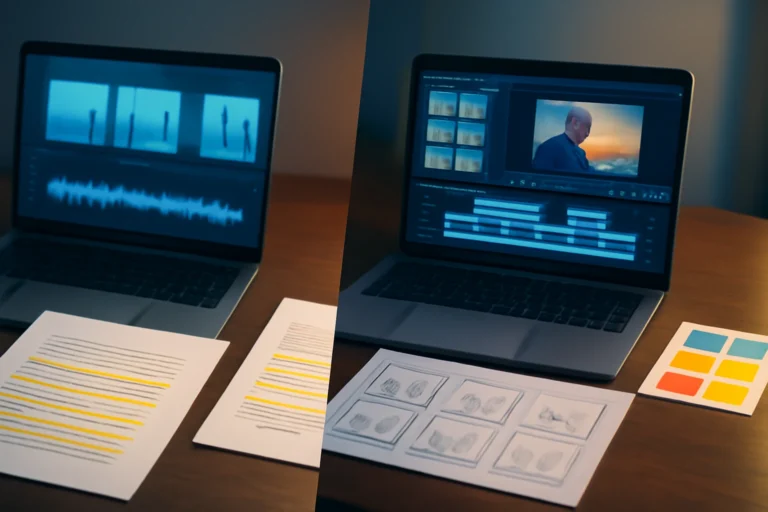
| One clean “best of both” pipeline | Often both | Record in Riverside → edit/repurpose in Descript, as long as handoffs and ownership are disciplined. |
Choose Riverside when descript vs riverside comes down to recording quality
Choose Riverside if you record remote guests often, can’t afford to lose a take, or need dependable local tracks with recovery behavior that protects you when someone’s connection drops. For many teams, Riverside pays for itself the first time it prevents a ruined interview.
Choose Descript when editing speed, transcript edits, and repurposing matter most
Choose Descript if post-production is your bottleneck: cutting down long recordings quickly, reshaping the structure, removing verbal filler, generating captions, and turning one session into multiple social-ready clips. It’s built for creators who want editing to feel more like writing and revising than living on a traditional timeline.
The common “use both” setup (and when it’s worth the complexity)
A common workflow is Riverside for remote capture, then importing into Descript for transcript-based edits and repurposing. This is worth it when responsibilities are clear (who owns recording vs editing) and your naming/versioning is consistent. If those basics aren’t in place, two tools can create avoidable chaos: duplicate files, inconsistent “final” versions, and approvals happening on the wrong export.
Head-to-head: the criteria that actually decide the purchase
Recording quality and reliability (remote sessions, local tracks, sync, recovery)
This is where Riverside typically wins for podcast and interview teams. “Recording quality” isn’t just resolution—it’s what happens when a guest drops, a browser hiccups, or an upload stalls. The questions that matter are practical: do you get usable separate tracks, how well does the platform recover from interruptions, and how painful is it to salvage a session when one participant’s file is delayed or incomplete?
Descript can handle recording scenarios too, but if remote reliability is the non-negotiable requirement, many teams prefer to treat capture as the priority and accept that everything downstream (edits, captions, clips) is rebuildable.
Editing workflow and speed (transcript editing, timeline control, learning curve)
Descript is usually the stronger choice if you want to edit by reading and deleting words, then fine-tune with more traditional controls where needed. Transcript-driven editing can remove hours from early drafts, especially for interview podcasts, training videos, and internal comms where structure and clarity matter more than complex visual effects.
Riverside’s editing is often sufficient for trims and quick outputs, but many creators still prefer to do the heavy lifting in a dedicated editing workspace. If you’re comparing other editing-first options for turning long videos into publishable cuts, the trade-offs in HeyGen vs Pictory can also help clarify whether you need a repurposing-centric tool or a recording-centric one.
AI features for creators (cleanup, filler removal, captions, clip creation)
Both platforms sit in the AI Video category and both promote time-savers, but you’ll get the best outcome by judging AI features on revision reduction, not the demo. The recurring wins for many creators are straightforward: removing filler words/pauses, generating captions, and producing repeatable clip outputs without reinventing your process every episode.
Keep expectations realistic with “AI cleanup.” It can improve intelligibility, but it won’t fully fix a poor mic, echoey room, or clipped audio. Results vary based on the speaker, the room, and how aggressively you push noise reduction before artifacts become distracting.
If your “AI video” need is less about editing recordings and more about producing presenter-style videos, it’s usually better to compare avatar-focused tools separately (for example, HeyGen vs Colossyan).
Audio polish (leveling, room tone, and what “good enough” sounds like)
For spoken-word content, consistent loudness and understandable dialogue beat fancy effects. Evaluate how each tool handles leveling across multiple speakers and what happens to sibilance, room tone, and plosives. If guests often record in untreated rooms, prioritize the tool that gives you the most reliable raw capture—because polishing is always easier than rescue.
Video workflow (layouts, screen share handling, b-roll needs)
Riverside is often chosen for session layouts and screen-share-heavy recordings, where stable capture and clean separation of tracks matters. Descript is often chosen for transforming a long recording into multiple deliverables: captions, aspect-ratio variants, and repeatable templates for shorts.
If your workflow depends on heavy b-roll, motion graphics, or compositing, you may still export into a dedicated editor. In that case, decide which platform gets you the cleanest exports with the least friction. If you’re exploring adjacent workflows where you’re building visuals from stills rather than recording sessions, AI tools to animate photos into video is a useful parallel read.
Collaboration and review (comments, ownership, version clarity)
Collaboration isn’t about how many people can open a project—it’s about how safely you can change your mind. Look for predictable review links, clear role boundaries, and version behavior that doesn’t create “final_v7_really_final” exports. If approvals are a real part of your process, pick the tool that reduces back-and-forth, not the one with the longest feature list.
Exports and publishing workflow (stems, captions, aspect ratios, quality)
Exports are where hidden friction shows up: multi-track audio downloads, caption file formats, different aspect ratios, and resolution constraints that may depend on plan tier. Before you commit, confirm what you can export on the plan you’ll actually buy—and test a real project end-to-end, including captions and any handoff to other editors.
Pricing and plans: what you’re actually paying for
Cost drivers that surprise buyers (limits, storage, multi-track, premium AI)
The biggest surprises are usually limits: recording hours, storage caps, multi-track exports, higher resolutions, and whether certain AI features are gated by tier or usage limits. Because packaging changes, verify current plan details right before purchase—especially if you’re rolling the tool out across a team.
Estimate monthly cost by team size and output volume
- Count sessions: How many recordings per month, and how long are they?
- Count outputs: How many final exports (full episode + clips) do you publish?
- Count collaborators: Who needs paid access vs review-only access?
- Identify the bottleneck: If editing time is your cost, Descript’s value rises; if reshoots are your cost, Riverside’s value rises.
Best for: match the tool to your use case
Interview podcasts (remote guests, consistency, repeatable post-production)
If your show depends on remote guests, Riverside is often the safer recording choice. Pair it with Descript if your editing rhythm is transcript-first: cut tangents, tighten answers, and turn one interview into multiple clips without spending your week on timeline micromanagement.
YouTube creators (talking head + screen share, frequent clips)
If you record talking head plus screen share and care most about dependable capture, Riverside can own the session. If you publish frequent shorts, Descript tends to speed up the repurposing loop: captioned clips, quick trims, and structured edits that feel closer to drafting than traditional editing.
Marketing teams and agencies (throughput, approvals, templated deliverables)
Agencies often benefit from splitting responsibilities: Riverside for consistent capture across many clients, and Descript as an editing hub for faster turnaround and predictable clip formats. The catch is operational: using both only works if you enforce file naming, define ownership, and keep a single approved “final” location to prevent version drift.
Educators and internal comms (trainings, updates, lightweight editing)
If you’re recording lectures, trainings, or internal updates, you may value speed and clarity over perfect aesthetics. Descript can be a strong fit when your main work is cutting, cleaning, and adding captions. If you bring in remote presenters frequently, Riverside can reduce the risk of a bad session.
Decision checklist and final verdict
8-question checklist to pick the winner in under 2 minutes
- Will one failed remote session cost you more than a month of software?
- Do you require local tracks and predictable recovery when connections drop?
- Is your primary bottleneck editing time (not recording time)?
- Do you prefer transcript-based editing over timeline-first editing?
- How often do you publish clips from long-form content?
- Do you need multi-person approvals, comments, and clear version ownership?
- Do you need stems, caption formats, and multiple aspect ratios every week?
- Can your team handle a two-tool workflow without storage and naming chaos?
Final recommendation: pick one tool, or pair them intentionally
If you want one tool only, choose Riverside when capture reliability is the non-negotiable requirement, and choose Descript when you’re primarily buying speed in editing and repurposing. If your pipeline is remote-first and clip-heavy, pairing them can be the most practical outcome—as long as you document handoffs, define where the “source of truth” lives, and keep version control disciplined.
Before you commit, run a real pilot: one remote session, one full edit, and one batch of clips. That test will surface plan limits, export constraints, and whether the tool fits how your team actually works.
Frequently Asked Questions About descript vs riverside
Is Riverside better than Descript for remote podcast interviews?
Often, yes—if your main risk is remote guest quality and connection hiccups. Riverside is widely chosen as the capture tool because it focuses on reliable remote recording and higher-quality local tracks. Descript can record too, but many teams prefer Riverside when the session itself can’t fail.
Can Descript replace Riverside for recording, or should I use both?
Descript can replace Riverside if you mostly record solo, record in stable conditions, or don’t need a dedicated remote-capture workflow. Using both can be ideal when you need Riverside for capture and Descript for fast transcript editing and clip production—just be ready for file handoffs and tighter process discipline.
Which is easier for beginners: Descript or Riverside?
Beginners often find Riverside easier for recording because it’s focused on session setup and capturing tracks. Descript can feel approachable for editing once you understand transcript-based edits, but it’s a bigger production workspace overall. The easiest choice depends on whether you’re learning recording or editing first.
Does Riverside have the same AI editing features as Descript?
Not typically. Riverside includes helpful creator features, but Descript is usually the deeper AI-assisted editing environment, especially for transcript-driven cutting, cleanup workflows, captions, and repurposing. Capabilities change frequently, so confirm current feature lists, limits, and any AI usage systems before committing.
Some links in this article are affiliate links. If you buy through them we may earn a commission, at no extra cost to you. It never affects which tools we recommend.
Tools covered in this guide
 Descript
Edit video and podcasts by editing transcripts with AI-assisted production tools.
From ~$12/mo
Descript
Edit video and podcasts by editing transcripts with AI-assisted production tools.
From ~$12/mo
 Veed.io
Browser-based video editing with AI captions, cleanup, and content repurposing tools.
From ~$12/mo
Veed.io
Browser-based video editing with AI captions, cleanup, and content repurposing tools.
From ~$12/mo
 InVideo
Create and edit videos from prompts, scripts, stock media, and templates.
From ~$20/mo
InVideo
Create and edit videos from prompts, scripts, stock media, and templates.
From ~$20/mo